


Clinical Cognitive Neuroscience Center
Research
Cognitive and Behavioral Assessment
Cognitive and Behavioral Assessment
Measuring Cognition and Behavior
We assess cognition and behavior with standardized clinical and neurocognitive measures, computational modeling of task behavior, eye-tracking, and digital phenotyping.
Clinical and Neurocognitive Assessment
At baseline and follow-up visits, participants are assessed with standardized clinical rating scales, including the Positive and Negative Syndrome Scale, the Scale of Prodromal Symptoms, the Yale-Brown Obsessive Compulsive Scale, and measures of depression, anxiety, and global functioning. A neurocognitive battery covers general intelligence, verbal and visuospatial working memory, verbal learning and memory, visuospatial construction and memory, processing speed, executive function, and verbal and design fluency. We also assess social cognition, including theory of mind, and emotion regulation.
Beyond conventional test scores, we derive new measures from standard tasks. For example, semantic clustering in the verbal fluency task predicted remission in individuals at clinical high risk for psychosis (Choe et al., J Psychiatry Neurosci, 2023).
Computational Modeling of Behavior
We combine behavioral tasks with computational models to estimate latent cognitive processes, such as how the brain arbitrates between goal-directed and habitual control.
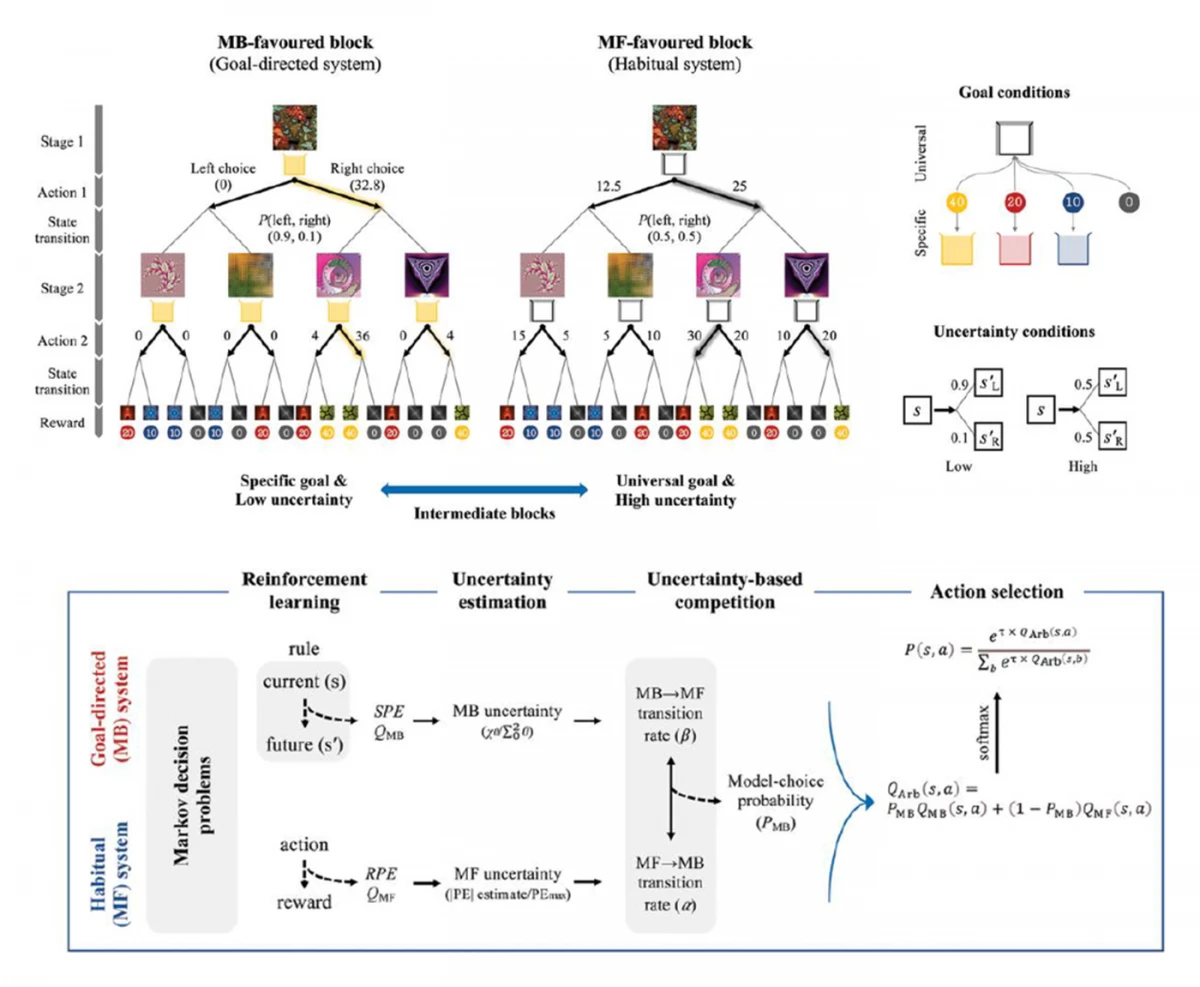
A two-stage decision task manipulating goal and uncertainty conditions (top), and an uncertainty-based arbitration model between goal-directed and habitual systems (bottom) (Kim et al., Brain, 2024).
Eye-Tracking
We use eye-tracking to capture how participants organize visual information. Eye movements during encoding of the Rey-Osterrieth Complex Figure revealed impaired organizational strategies in patients with OCD (Kim et al., Sci Rep, 2021). Building on this work, we developed an eye-tracking system with a deep learning model that assesses executive function from gaze patterns.
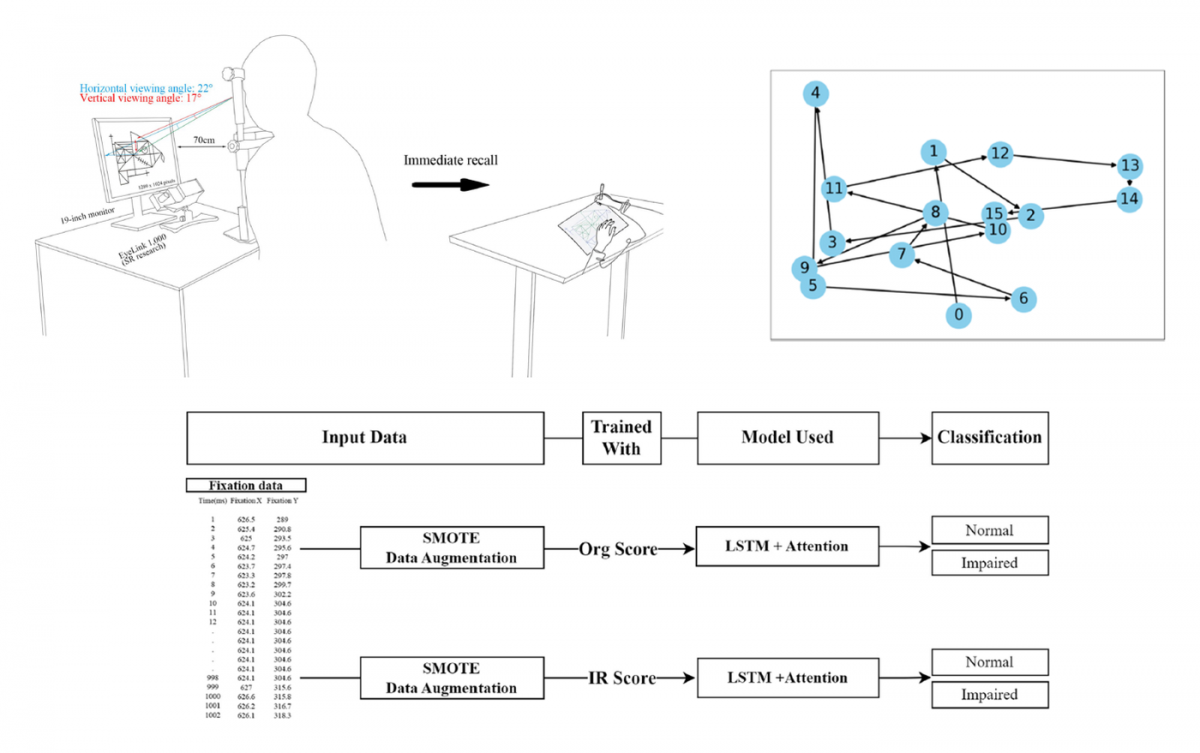
Eye-tracking setup during the Rey-Osterrieth Complex Figure Test, an example of gaze transitions between figure elements, and the deep learning model used to classify executive function (Kim, Lee et al., Sci Rep, 2024).
Digital Phenotyping
We extract digital markers of mental health from everyday device use, such as keystroke and stylus data recorded while students solve learning tasks on tablets.
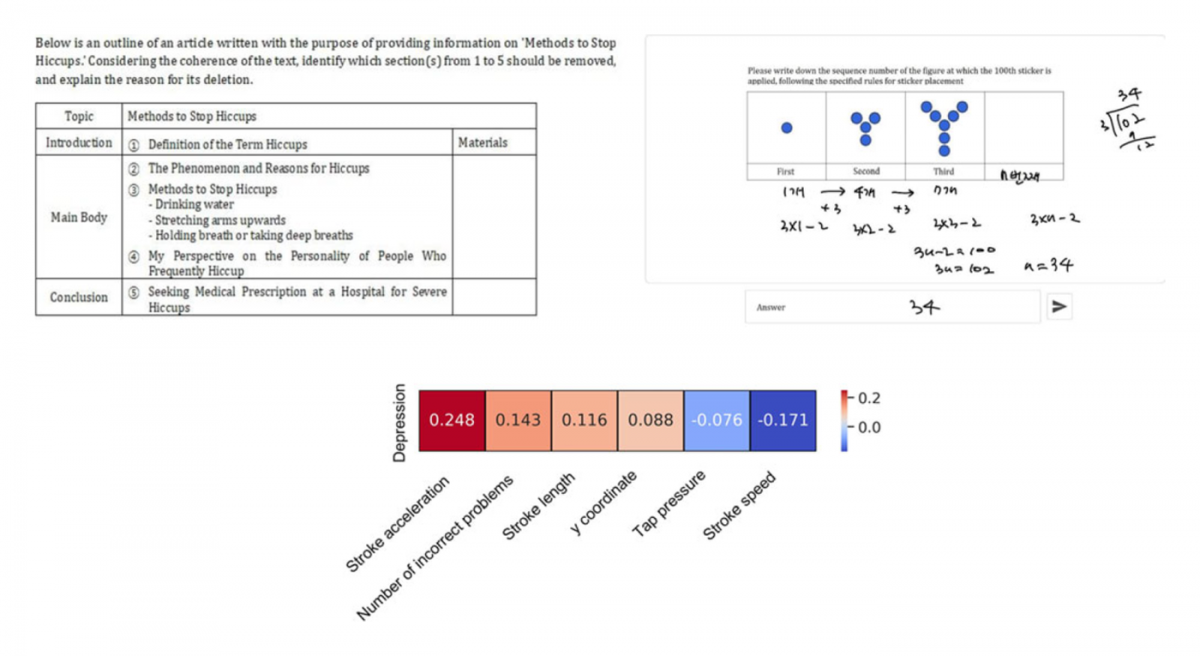
Examples of tablet-based learning tasks (top), and associations between stylus and keystroke features and depressive symptoms in adolescents (bottom) (Jang et al., Psychol Med, 2024).