Proteomic profiling in the progression of psychosis: Analysis of clinical high-risk, first episode psychosis, and healthy controls
- Journal
- Journal of Psychiatric Research
- Vol
- 169
- Page
- 264-271
- Year
- 2024
Background and hypothesis
Recent evidence has highlighted the benefits of early detection and treatment for better clinical outcomes in patients with psychosis. Biological markers of the disease have become a focal point of research. This study aimed to identify protein markers detectable in the early stages of psychosis and indicators of progression by comparing them with those of healthy controls (HC) and first episode psychosis (FEP).
Study design
The participants comprised 28 patients in the clinical high-risk (CHR) group, 49 patients with FEP, and 61 HCs aged 15–35 years. Blood samples were collected and analyzed using multiple reaction monitoring-mass spectrometry to measure the expression of 158 peptide targets. Data were adjusted for age, sex, and use of psychotropic drugs.
Study results
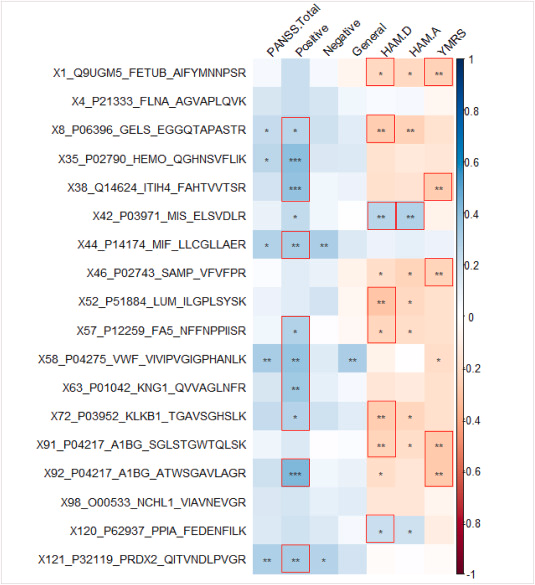
A total of 18 peptides (17 proteins) differed significantly among the groups. The protein PRDX2 was higher in the FEP group than in the CHR and HC groups and showed increased expression according to disease progression. The levels of six proteins were significantly higher in the FEP group than in the CHR group. Nine proteins differed significantly in the CHR group compared to the other groups. Sixteen proteins were significantly correlated with symptom severity. These proteins are primarily related to the coagulation cascade, inflammatory response, brain structure, and synaptic plasticity.
Conclusions
Our findings suggested that peripheral protein markers reflect disease progression in patients with psychosis. Further longitudinal research is needed to confirm these findings and to identify the specific roles of these markers in the pathogenesis of schizophrenia.